
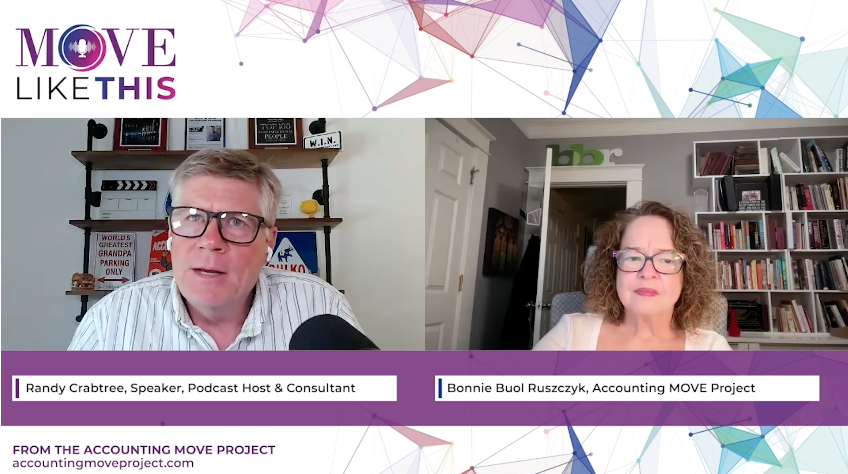
 In this episode of MOVE Like This, host Bonnie Buol Ruszczyk talks with Randy Crabtree, speaker, consultant, host of The Unique CPA podcast, and recently retired co-founder of Tri-Merit, about vulnerability, leadership, and why the accounting profession may need to rethink some long-held assumptions about what strong leadership looks like. Randy’s perspective is deeply personal. After suffering a stroke 12 years ago, he spent years dealing with panic attacks, PTSD, and depression, an experience that forced him to recognize that strong leadership doesn’t mean having all the answers or carrying everything yourself.
That realization eventually changed how Randy approached his own career. Although he founded Tri-Merit and had served as managing partner from the beginning, he recognized that the role wasn’t where his strengths were best suited and stepped aside. His decision prompted others in the firm to reconsider their roles as well, and Randy says the firm grew its revenue tenfold over the next five years as people moved into positions that better matched their strengths. But Randy and Bonnie also discuss an important complication: not everyone has the same freedom to be vulnerable. Women have told Randy that behaviors celebrated as authentic in male leaders can still be interpreted as weakness or excessive emotion in women, raising important questions about what firms really mean when they encourage leaders to bring their whole selves to work.
The conversation also looks ahead to a profession being rapidly reshaped by AI and automation. Randy sees an opportunity for accountants to spend less time on traditional tasks and more time advising, solving problems, and building relationships, but only if firms rethink how they define value. Clients aren’t buying hours, he argues; they’re buying expertise, answers, and peace of mind. If technology simply allows accountants to complete work faster and then fill those newly available hours with more work, the profession risks carrying the same burnout problems into its future.
Key Takeaways
- Vulnerability Can Give Others Permission to Be Honest:When leaders acknowledge mistakes, limitations, or even that they are in the wrong role, they create space for other people to evaluate where they can contribute most effectively.
- Failure Has to Be Safe if Firms Want Innovation:Accounting is changing too quickly for firms to rely exclusively on what has worked before. Employees need permission to experiment, make reasonable mistakes, learn, and adapt without fearing that every failure will be held against them.
- Women Still Face a Different Standard Around Vulnerability:Behaviors viewed as authentic or courageous in male leaders may still be interpreted as weakness or excessive emotion in women. Firms cannot encourage vulnerable leadership without recognizing that not everyone currently experiences the same freedom to practice it.
- Being Human Can Strengthen Professional Relationships:Credentials and technical ability establish competence, but relationships are built between people. Allowing professionals to share more of who they are can strengthen trust and connection with colleagues and clients.
- The Profession Needs to Stop Equating Time With Value:As AI and automation reduce the time required for traditional accounting work, firms have an opportunity to define value around expertise, outcomes, and peace of mind rather than hours worked. Simply filling newly available capacity with more work risks perpetuating the same burnout problems in a more technologically advanced profession.
We are pleased to partner with CPA Trendlines for podcast distribution. Anyone can listen to the episode, but you need to be a subscriber to watch the video version. Check it out here!